|
Welcome to my website! For years I've been trying to combine 2 of my interests-photography and studying the American Revolution. By photographing American Revolution reenactments, I can now combine both interests. I now live in the Philadelphia area, so I'm centrally located to photograph many of the reenactments in the Delaware Valley region. My future goal is to photograph every major American Revolution reenactment. Plus, it's fun, and all reenactors want to share stories; they're storytellers! Ken "It was a pleasure to exchange cards. We are out of Lebanon, CT and I have reviewed website and was truly moved by your art." Brown's Company Attending the Battle of Newtown Reenactment againI haven't attended the Battle of Newtown reenactment in Elmira, NY since 2010. Hard to believe it's been that long! One reason is that the event hasn't been held in years. So I was excited to attend again the weekend of August 24 & 25. My photo galleries from my 2 previous Newtown events in 2010 and 2009 have accumulated the second & fourth most number of web site visitors on my site American RevolutionPhotos.com!
This event is to commemorate General John Sullivan's major battle victory over British Loyalists/Six Nations tribes, as part of the Sullivan Expedition, in August 1779. This campaign was ordered by George Washington to destroy towns & crops of the Six Nations that were terrorizing settlers in upstate New York & western Pennsylvania regions.
My GPS stated it would take 3 1/2 hours to drive from Media, PA to Newtown. I left early, around 6:45 am., selecting the major highways to save time. Unfortunately, this was the wrong choice! Highway 81 was closed about 25 miles from Binghamton, NY. A tractor-trailer flipped over causing everyone to exit in a small rural town that became overwhelmed with traffic. I arrived in Newtown almost 2 hours late, after 12 pm.
For the afternoon I visited the American/British and Indian camps. Late in the day was a reenactment in the woods close to the Indian village. But it was difficult to get many good photos with the reenactors skirmishing in the thick woods. Around 4:00 pm I was tired; it had been a long day. I had researched what restaurant in the area to eat and chose one off the beaten path, the Maple Lawn Dairy Restaurant. It was a pleasant meal and the waitress provided me with directions to my hotel. I now try to eat at local restaurants on my photo trips. When I arrived at the hotel I crashed. I was up early on Sunday morning. Had breakfast and arrived at Newtown around 8:30 am. When I first arrived the fog covered the area.
After taking the photo above I noticed 2 reenactors near the Newtown Battlefield Monument. Knew it would make a good photograph.
Early in the morning was the church service. For Sunday reenactment events I'll try to attend. It's good for the soul.

Later in the morning was a new British soldier induction ceremony. Best wishes!
My favorite event was the woods walk. Continental soldiers escorting refugees through enemy territory.
Late in the day was the reenactment battle. It was fun because the action was nonstop; on both sides of the road.
Need to be careful in the woods!
Thanks for reading. Blog # 17 will be posted in November 2019.
Interview with Bryn Kelley-Bride
In my June Reenactment Wedding & July Locust Grove Encampment & Wedding/Reception blogs I described the American Revolution reenactment wedding that I was privileged to photograph in late April at Locust Grove in Louisville, KY. It was a fantastic experience to be part of Bryn Kelley's and Greg Hudson's special day!
Contentment! I had asked Bryn to be interviewed for a future blog before the wedding. She gladly accepted. I knew this event would make for a great interview. Interview with Bride Bryn Kelley- BEFORE THE WEDDING 1) How long have you & your husband become active in American Revolution reenacting? We have 38 years combined experience. My husband was born into the hobby, so he has been doing this for 31 years. I, on the other hand, have been reenacting for about 7 years. 2) How many events do you attend yearly? Do you have a favorite? We typically attend seven or eight events a year. One of our favorites is definitely the Spring Encampment at Locust Grove, where we were married this year; another favorite is the Vermillion Valley Encampment at Forest Glen Nature Preserve in Illinois. 3) When did you decide to have a reenactment wedding? From the minute we knew we were getting married we knew it would be a reenactment wedding, it just seemed perfect. Reenacting is how we met and has been important in many big steps in our relationship.
The beautiful bride on her day. 4) What was your families & friends reaction to this idea? Admittely, most of our friends who were not reenactors were a little confused. Once we explained it, they thought it was really unique and exciting. Our friends who do reenact were very excited to see what we were going to do with our wedding. Our family thought it was a lot of fun and enjoyed putting together their outfits. 5) How long did the wedding preparation take? The wedding planning took roughly 14 months.
Proud Father-Law! AFTER THE WEDDING 1) How was your wedding day? It was wonderful and exhausting. It meant so much to have people there who love us. 2) Did everything go as planned? While weddings never go as planned and it rained, it all made for fond memories 3) Would you have planned anything differently? I wouldn’t change a thing.
Cutting the Wedding Cake. 4) What was overall reaction afterwards from your family/attendees? Everyone was tired but had a really good time, they were all very happy for us and excited that they got to partake in the celebration. 5) If another couple was planning a reenactment wedding what advice would you give? Hire a day of coordinator that is not family. We didn’t and it would have been nice to have.
The Wedding Ceremony. Thanks for reading. Blog # 16 will be posted in October 2019.
Interview with Ron Mehalko-SutlerWhat is a sutler? Ever heard of the word before? From the Oxford English Dictionary, it means "a person who followed an army and sold provisions to the soldiers." At many American Revolution reenactment events, besides being exposed to army camp life and battle reenactments, you will find merchants selling their merchandise. Some cater to reenactors and others such as Ron Mehalko founder of Revolution Wear focus mostly to spectators.
I've known Ron since I started photographing American Revolution reenactments. I believe we met at a Battle of Monmouth event? He was setting up his table early in the morning. I introduced myself and mentioned being a photographer. Since then at different events I would always visit & say hello.
Ron's spot at the recent Battle of Monmouth reenactment! I asked Ron to be interviewed a few months ago. He graciously agreed. To fully appreciate the reenactment experience spectators should wander around the merchant's tables. You'll always discover interesting items/souvenirs. Interview with Ron Mehalko of Revolution Wear- 1) How long have you been a sutler (merchant) at American Revolution events? I actually started out selling wholesale to Revolutionary Historic Sites and then pursed the idea of also selling retail at reenactments? Attended my first reenactment in the spring of 2002. It was a tough start but was able to convince those in charge and other participants that what I wanted to do was a good fit. 2) How did you create Revolution Wear and start your business? I started thinking about the number of historic sites I visit and how disappointed I always was in what was offered for sale in the gift shops. I thought I could provide a better alternate and it seemed to work gauging from the feedback and reorders I received.
Setting up early in the morning! 3) Why did you focus on US colonial history? My dad gave me a book on Thomas Jefferson and once finished my daughter and I took our first trip to Colonial Williamsburg. After that one visit we were hooked. The Revolution and 18th century culture have been a huge interest of mine ever since. All of this started me on the path to thinking about #2 which lead to #1. 4) How many events do you usually each year? Typically about 6-8 events each year.
The sutlers area. 5) How do sutlers add to the reenactment experience? It allows the public to see up close the type of clothing and accompaniments which the soldiers use day to day and for battle. There was always an 18th century solution to all the little problems just as today. I however focus on the history of the revolution using symbols and flags on my apparel as a reference point. I enjoy talking to the visitors about the symbols and how it had an impact on the soldiers and public. 6) Are spectators surprised that vendors particpate in reenactment events? Not so much surprised but there is a general lack of knowledge of what a sutlers ‘job’ was and how they were a benefit to the soldiers. I often point to the Civil War (which most people seem to have a better grasp of) and how the photographers followed the army to provide a service and I will say we have the same function just different.
Busy with customers! 7) What items do you stock? Which ones sell the best? My sutlery is very different than all the rest. I do not sell 18th century items which meant Revolution Wear was not readily accepted. But eventually it was which I think was due to everyone seeing that I sold quality merchandise very pertinent to the Revolution, the public was interested in what I sell and had to say and the openness and good will of the other sutlers. 8) Do you create your merchandise designs? Yes, and no. I started out using flags from the Revolution as the basis of my designs on the hats. That evolved into using the same basic designs on tee shirts and polos. Having the tee shirts as a ‘pallet’ allowed me to expand to new printed designs but still all based on the American Revolution. I have always shied away from altering the symbols and having oversized multi-colored designs as many others offer. 9) How many of your customers ask you questions about the American Revolution? If yes, what was the most unique question you were asked? I do get a number of questions, mostly about the symbols which are on the shirts and hats and I always take any opportunity to give an explanation and many times a bit of the back story of the who and why. Most times I have to stop myself from going on and on. To educate the public in any small way has always been a goal of mine and I enjoy it a little too much. 10) How do view the future of American Revolution reenacting? I am concerned about the future of it all. I see the soldiers getting gray but do not see many younger recruits to take their place. It most likely is not as bad as I see it from standing under my fly as they march by but from what I have heard it is a concern in general. Thanks for reading. Blog # 15 will be posted in September 2019.
Locust Grove Encampment & Wedding/ReceptionIn last month's Reenactment Wedding blog post I shared my excitement in photographing a reenactment wedding in KY. For this blog, I'll recap that special day.
I arrived at Locust Grove, the 55-acre 18th century restored farm site, around 9 am on a beautiful spring morning. Many of the reenactors were still setting-up; so I met with them & walked the grounds and outbuildings. Others were preparing breakfast.
The Locust Grove Revolutionary War Encampment is an annual event. The bride and groom met here a few years ago. These reenactors are part of The North West Territory Alliance (NWTA). This is an American Revolutionary War reenactment organization located in the Midwest.
The day was for the public to meet & greet with the soldiers and camp followers. Later in the day, there was a solemn salute at the cemetery for the Locust Grove descendants and a tribute for a recent reenactor's death. In the late afternoon was a small tactical demonstration.
Below is Lieutenant Greg Hudson (groom) of the Illinois Regiment of the Virginian State line.
The weather was perfect ...until about 2 hours before the wedding. Later in the afternoon, it got cloudy and then a light shower started. The ceremony was delayed for almost an hour. The wedding commenced Around 5:30 pm outside in front of the house.
The beautiful bride and her parents!
The wedding Ceremony.
The bride/groom plus bridesmaids/groomsmen and their children.
Outside reception & wedding cake.
And of course some dancing after dinner!
Thanks for reading! Blog # 14 will be posted in August 2019.
Reenactment WeddingPhotographers want to tell a story with pictures. When sharing my photos with the public, I'm hoping to instill an appreciation & understanding of soldiers/camp life during the American Revolution. That has always been my goal in photographing American Revolution reenactments!
On my web site Americanrevolutionphotos.com, I have over 16,000 visitors with over 6,500 images posted. The comments about my site have been overwhelmingly positive. One e-mail that I received, in late December 2017, was the beginning of an extraordinary adventure that I will never forget! The e-mail was sent from the mother of a bride to be from the Cincinnati, Ohio area. Her daughter was getting married in April 2019 at a historic home in Louisville, KY. Would I be interested in photographing a reenactment wedding? Wow.
Everyone at this wedding including the bridal party & guests would be in colonial attire. The event would be held at Locust Grove, a 55-acre 18th century restored farm site. This 2 stories Georgian brick house was the last residence of famous General George Rogers Clark. From this trip, I learned that Clark founded the City of Louisville. Did you know?
The wedding would be held on the same day as a Revolutionary War Encampment event that was open to the public. Shortly after the encampment ended, around 4pm would be the ceremony. Immediately afterward would be the reception with everyone in the back of the house. I was upfront about never photographing a wedding before. Then I asked how did they find me?
They were looking for a photographer who was familiar with and understood reenactments. After searching numerous web sites and I was selected. What an honor to be asked to photograph, such an important event, a couple's wedding! I knew that this experience could be a once in a lifetime. It was one of the easiest yes decisions I've made in my life. After the arrangements were finalized, I had over 1 year to prepare for the trip. In next month's blog, I'll describe the encampment & wedding experience. Thanks for reading! Blog # 13 will be posted in July 2019.
Visiting Fort BoonesboroughI’m a baby boomer. My favorite TV program in the 1960s was Daniel Boone, starring Fess Parker. The show was about Boone and his family in KY during the American Revolution. He had led a group of settlers through the Cumberland Gap in 1775 and established Ft Boonesborough. At the time it was one of the earliest English settlements west of the Appalachian Mountains.
The 6- year long running hour-long series was set in the 1770s and 1780s. As a young fan, I didn’t wear a coonskin cap like Parker but instead played with a Kentucky rifle cap gun.
Since I live in the Philly metro area I've had the opportunity to visit the Daniel Boone Homestead, where he was born. It's located in Birdsboro, PA, a short distance from Reading, PA. Amazingly, many years ago I visited The Historic Daniel Boone Home in Defiance, MO when living in the St. Louis area. Boone moved here in 1799 and died at 85 in 1820. Why did I travel to KY for the first time and visit Fort Boonesborough? That's an amazing story for next month's blog. So I was excited to visit the restored fort, that is part of the KY State Parks system. When I arrived on Friday, 10AM it was a cold rainy morning. Immediately, after seeing the fort I recalled fond childhood memories watching the TV show. I gathered my camera equipment and proceded to the main entrance. You can't miss the large Fort Boonesborough Monument close to the entrance. The inscription reads
After paying a nominal admission fee it was suggested I watch a short film in the orientation center. Then I strolled in the fort taking pictures. Eventually, visited the interpreters in the cabins. One retired schoolteacher, who started 2 weeks ago, was learning how to make candles.
So is this the original fort? No. But, in 1974, a reconstruction of the historic fort was dedicated. It's located on higher ground than the original structure and it is made up of 10,000 southern yellow pine logs.
The original Fort Boonesborough site is located in the park and a short distance from the Kentucky River.  
It was so much fun to reminisce! I hope to return and experience the annual battle reenactment of the 1778 Siege of Boonesborough held in late September. The event commemorates the 1778 attack on the fort by Native Americans and French Canadians during the Revolutionary War.
FUN FACT: Daniel Boone was a waggoner at the infamous Braddock’s Defeat in 1755. George Washington, Second in Command, gained fame in this battle by leading an organized retreat after the British Commander General Edward Braddock was fatally wounded in the ambush.
Thanks for reading! Blog # 12 will be posted in June 2019.
Founding Father from Williamsburg, VAWhich founding father was the mentor/teacher to Thomas Jefferson & was probably murdered by his 18-year-old grand-nephew? Need another hint? His home in Williamsburg,VA was headquarters for George Washington during the siege of Yorktown in the fall of 1781. That would be George Wythe one of the most highly respected & leading statesmen in the Revolutionary era! Here are some amazing facts about him.
In the 12x18 foot painting of the Declaration of Independence by John Trumbull displayed in the US Capitol rotunda George Wythe is partially visable in the painting.
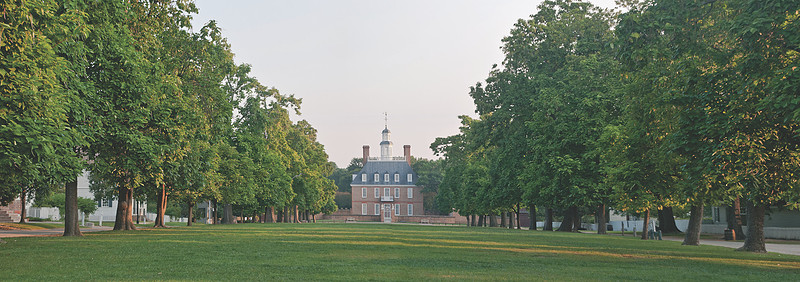
Always in my regular visits to Colonial Williamsburg, read blog# 3 www.americanrevolutionphotos.com/blog/2018/9/my-colonial-williamsburg-experience, I'll always stroll around the palace green in front of the Governor's Palace. The palace green is 9o0 feet long lined on both sides by southern catalpa trees, just like it was in the 18th century. On the left, almost in the middle of the street is the Wythe House, a 2 story 1:2 ratio brick building. It's considered by many to be the most handsome colonial home in Williamsburg.
George Wythe's house porcelain collectable
Wythe's most prominent law student was Thomas Jefferson. He lived in his home for 5 years from 1760. Jefferson wrote about his mentor "No man ever left behind him a character more venerated than George Wythe. His virtue was the purest tint; his integrity inflexible, and his justice exact; of warm patriotism, and devoted as he was to liberty, and the natural and equal rights of man, he might truly be called the Cato of his country...(He was) my faithful and beloved Mentor in youth, and my most affectionate friend through life." In 1780 the capital moved from Williamsburg to Richmond. After Wythe's wife's death in 1791, he accepted an appointment as Judge of VA's Court of Chancery in the new capital. His death a few years later in 1806 at age 80 was tragic. His 18-year-old grand nephew George Wythe Sweeney, who was living with Wythe at the time, was suspected of poisoning him. He had already committed several capital crimes. Concerned that Wythe's had bequeathed generous amounts to his former slaves, Sweeney is thought to have added arsenic to possibly coffee or strawberries. One former slave died quickly, Wythe after 2 weeks and the other former slave survived. Sweeney was brought to trial but was acquitted because of only circumstantial evidence against him. Wythe's buried in St. John's Episcopal Church churchyard in Richmond. His funeral was the largest in VA at that time. When you visit Colonial Williamsburg definitely visit his historic house!
Thanks for reading! Blog # 11 will be posted in May 2019.
United States CapitalsWashington D.C. became the U.S. Capital on July 16, 1790. How many other capitals has the U.S. had? Difficult question, right? Thought of an answer? The number is 8. Okay, now can you name them? Most of us would know Philadelphia and maybe New York City. Then it becomes difficult. Here' the list.
1) Philadelphia, PA 5) Princeton, NJ 2) Baltimore, MD 6) Annapolis, MD 3) Lancaster, PA 7) Trenton, NJ 4) York, PA 8) New York City How many did you know? During the American Revolution, I learned in my grade school history classes that the Continental Congress had to skedaddle out of Philadelphia from the advancing British Army periodically. So when & where did they go? I didn't remember? It couldn't be too far? Right? Travel was difficult in the 18th century especially on horseback with few & terrible roads. For this blog, I decided to focus on the capitols during the American Revolution period from 1776-1783. The Declaration of Independence was adopted on July 4, 1776, in the Pennsylvania State House, now called Independence Hall, declaring independence from Great Britain. The Continental Congress then became the new government for the 13 American colonies.
At the end of 1776, the British Army was threatening Philadelphia. The Continental Congress members needed to flee on December 12, 1776, about 100 miles away to Baltimore, MD. The delegates chose Henry Fite's 3 story brick home/tavern, one of the largest homes in the area far enough away from possible British Navy bombardment. The delegates stayed until February 27, 1777. Below is a sketch of the building that was destroyed by fire in 1904.
With the British threat over the Continental Congress delegates reconvened at Independence Hall on March 4, 1777. Their reprieve didn't last long. After Washington's disastrous defeat at the Battle of Brandywine once again the delegates had to flee Philadelphia on September 11, 1777.
This time to Lancaster's County Courthouse in York, PA 65 miles away west on September 27, 1777 for 1 day. Yes, it was capital for only 1 day! I can only imagine how terrifying it must have been for the delegates. They were virtually fleeing for their lives. If caught, they were considered traitors and would have been hung! Seeking a more secure location the delegates fled 25 miles west of Lancaster, PA to the York County Court House in York, PA on September 30, 1777, where they convened until June 27, 1778. Below is a stock photo of the restored Colonial Courthouse in York, PA.
Once the British Army evacuated Philadelphia on June 18, 1778 for New York City the Continental Congress returned to Philadelphia. They found the conditions in Independence Hall deplorable. So it was decided to move to Philadelphia College, now The University of Pennsylvania, and convene from July 2, 1778, to July 20, 1778. The college in the 18th century was located at 4th & Arch Street. They gathered there for about 3 weeks until Independence Hall could be repaired. Once Independence Hall was habitable the Continental Congress met here until June 21, 1783. Even after the Victory at Yorktown, VA, essentially ending the American Revolution, the delegates had to flee once again. This time it wasn't the British Army invading Philadelphia but the disgruntled Continental Army demanding back pay. The delegates fled 40 miles northeast to Nassau Hall at the College of New Jersey (Princeton University) on June 30, 1783, until November 4, 1783. Isn't it amazing that the Continental Congress wasn't captured by the British Army during these years? What a remarkable story!
Thanks for reading! Blog # 10 will be posted in April 2019.
Dr. Benjamin Rush from Philadelphia, PA
The author proceeds to describe all his many of Rush’s accomplishments and why he should be remembered today. Here are some of his many achievements • Doctored to the poor in the Philadelphia slums; even during the smallpox epidemics • Only MD to sign the Declaration of Independence • Father of American Psychiatry & Veterinary Science • First Professor of Chemistry in America • Helped organize the first anti-slavery society in America • Suggested the title for Thomas Paine’s classic text, Common Sense • Known for his efforts to reform care given to the mentally ill • Opposed the evil effects of tobacco and alcohol • Founded Dickerson & Franklin colleges • Helped Meriwether Lewis prepare for the Lewis and Clark Expedition After reading Harlow Giles Unger’s book I now knew more about Dr. Rush. Living in the Philadelphia region made it easy to view his historical landmarks. Just in case there was another government shutdown I visited on Saturday, 2/9. The commute to the city was easy on a blustery, cold, windy, raw day. My first stop was the Christ Church Burial Ground to photograph his tomb, no luck. This cemetery, where Benjamin Franklin is also buried, is closed the months of January & February.
My next stop was The Portrait Gallery in the Second Bank of the United States, part of the Independence National Historical Park, located on Chestnut Street, between 4th and 5th Street. It houses the "People of Independence" exhibit. Below is his portrait.
Only a few blocks away from Independence Hall on 3rd & Walnut St. is a garden called the "Benjamin Rush Garden". This is the site where his home once stood.
Then why is Rush not remembered more favorably today? Maybe because he criticized George Washington, not once but twice, first as military commander and later as President. As Surgeon General of the Continental Army Rush was appalled with the medical treatment the soldiers were receiving early in the war. He complained often to Washington but felt nothing was being done to make conditions better. Rush angrily wrote a letter to VA Governor Patrick Henry with his concerns. Henry forwarded the letter to Washington. At that time another plot was developing among some Continental Generals to remove Washington as Commander in Chief of the Continental Army. Even though Rush wasn’t involved in that plot many in the Continental Congress assumed he was. He had no choice but to resign. When Washington was President Rush also criticized him for some of his executive decisions. In hindsight, probably not a good idea to question the universally revered Washington? Rush was not without controversy though. He believed in bloodletting, to the point of being obsessive. This is a process of withdrawing blood to help heal an illness or disease. It was a common medical practice for over 2,000 years. Rush administered this procedure to all his patients, no matter the ailment. But this procedure was becoming controversial. During the yellow fever epidemics in the 1790s, it destroyed his reputation & medical practice. President Adams helped during this difficult period by appointing him Treasurer of the Mint. Rush was able to continue in medicine for the rest of his career when in 1791 became Professor of Medical Theory and Clinical practice at the University of Pennsylvania.
Thanks for reading! Blog # 9 will be posted in March 2019.
Interview with Continental Soldier Olga LeakeDuring the American Revolution, there are a few examples of women soldiers in the revolutionary army fighting against the British. For some, this happened by virtue of their circumstances; such as the legend of Molly Pitcher. She supposedly attended the cannon of her fallen husband during the Battle of Monmouth in 1778. Research shows she was a composite of 2 women Mary Ludwig Hays McCauley and Margaret Cochran Corbin. Others concealed their sex and joined the army disguised as men. At all of American Revolution reenactment events, I’ve attended women participate mostly as camp followers (that term was not used in the 18th century). But not all. Some portray soldiers in both the Continental & British regiments. One of these women, Olga Leake, portrays a Continental soldier in the 3rd PA Regiment. Since I know & photographed her over many years I asked her to be interviewed.
Interview with Continental Soldier Olga Leake- 1) How long have you been reenacting? I’ve been reenacting since 2000. I had been teaching HS Social Studies to Special Education students and wasn’t interested in history until I had to teach it. Special Ed. Teachers in PA are trained for dealing with the needs of special learners and not in content areas. So it’s a DIY when it comes to subject areas and the Special Ed. Teacher has to be on par with a subject area teacher who went to school for that subject. When I did all the extra work to adequately cover the subject matter for my students, I realized history was pretty cool. In 2000, a student of mine reenacted Civil War with her parents and I thought that was the ultimate in history DIY. Her parents invited me to take part in an event at the Colonial PA Plantation. I was hooked from the start! 2) What interested you in being a soldier instead of a camp follower? I actually started out as a camp follower. First in CW, where I did a lot of campfire cooking, then in Rev. War, with a few period tweaks to those CW receipts. There were many times when I was the only female in the unit and doing all the domestic chores. When I would see the men come back from a battle, I found their comradery amazing. But all I was doing was cooking and cleaning. Then I would be all by myself when they went out to battle. I love campfire cooking but talking to a Dutch oven makes for dull conversation. So I took to photography to get closer to the battle. What I saw through the camera lens made me wish I was out there instead of sitting behind the yellow caution tape. After the battle, I would beat it back to camp and the guys would return, where I would hear the guys talk about the battle, the good, the bad and the ugly. All I had to contribute was, “Dinner’s ready.” It made me want a piece of the battle experience and I wanted to feel more a part of the unit by being one of “the boys”, rather than just with “the boys”-literally to be part of the band of brothers. I enjoyed what I was doing as a camp follower, but it was isolating and I wanted to feel the buzz and “see the elephant.”
3) How did you join the 3rd PA Regiment? Did you consider other units? It’s a bittersweet story. I had met someone while volunteering at Ft. Mifflin for Seige Weekend 2004. We had started to date in December 2004 and one of our dates was the Crossing, which was my first Rev War event. I thought I’d try Trenton and one of my friends in my CW unit was in the 3rd PA. He sponsored me for Trenton, as I didn’t want to impose on my new date. About two weeks after Trenton, my date suddenly passed away and I decided to stick with Rev War, so it didn’t feel that he was gone so quickly. His passing was bitter, but the 3rd PA was there and I was welcomed with open arms, and it became sweet. I never considered any other unit. Why try something else when you know you’ve found the best! The only thing that took me back a bit, was when I decided to soldier and did the research to find out about the Light Company. I knew I’d better start working out! 4) What was there first reaction when you expressed interest in joining? There was the positive reaction from the 3rd PA, as they were happy that they were getting someone who was an experienced campfire cook. But my family thought differently. I went from my Mom and Pop saying, “Why you do?”, as they both were WWII vets and emigrated to US in 1951. She was a nurse attached to the Russian Army and he was a POW, held by the Germans. So read their response with a Russian accent and wave your hands around for punctuation. My brother was a Vietnam vet and he thought it was seriously cool, especially since I used to get on his case about having firearms in the house. Then when I went soldier, I became a gun owner, and eventually of more than one.
5) Some women secretly fought in the American Revolution. Did you do research on this topic that peaked your interest? I did some light research but it was after the fact, once I had been doing soldier for a while. My research concentrated on being a (male) soldier. If I’m going to pass as a guy, I didn’t see the point in following some other female’s example. I needed to know what was expected of the (male) soldier and make it work for myself and how I would fit in the unit. The most interesting thing I found was once I dressed as a male, I started to act like one. I started to sit like a guy, use more colorful language and drink some unique beverages. Then there was the unusual itch and scratching thing. But that’s TMI. So I guess clothes really do “make the man.” 6) How many Rev War events do you attend yearly? Do you have a favorite one? Why? I don’t count how many events I go to. I try to get out to all of them and then start deducting. When it comes to favorite events, I think every event has something that keeps me coming back. It’s more that I have favorite or memorable thing from different events. I was born and raised in Philly and currently live in Delaware County, so anything close to home is close to my heart. 7) What is your greatest enjoyment from reenacting? Watching young people come to history and love it. I learned from books and really didn’t care about it. Until I had to teach it, it was boring. But I let my students guide me and tell me what they wanted to know. I stayed loosely within the curriculum and found that they were the real teachers. From them and their questions, I learned to love history, then become a reenactor, so I not only talk-the-talk, I walk-the-walk.
9) What’s your thoughts on the future of Rev War reenacting? We need to make way for the future of reenacting by embracing the young people who are coming to it now. They’re already ahead of the veteran reenactors when it comes to being historically correct, by their age alone. That was the easy part. It’s up to the veteran reenactor to guide and mentor the young people who will pick up the mantle of reenacting. If that doesn’t happen, then history dies twice-once, for the reenactors, and twice, for humanity. We need the youth to carry on “the story.” 10) How do you learn more about colonial history? I found the “hook” for my SP ED students started by the historical movies. The old productions really could be horrendously inaccurate, but that’s where you do the research and debunk, while they watch. Then visit historical sites. Once I retired from teaching, I began to work at Ft. Mifflin, where I am an educator and tour guide. I had the best experience ever in September 2018, a few years after leaving the public education arena, to have two young girls come up to me at Paoli Battlefield’s annual Heritage Day, and ask me if I worked at Ft. Mifflin. I said yes and found out that they had been in one of my Rev War Soldier Life classes at the fort. Better yet, I was dressed at Paoli, as an 1812 Marine. They also saw me at the 2018 Malvern Memorial Day parade and I was kitted up as a Federal CW Hospital Steward. So not only did they learn some history, but they also had an example of what a woman could do. I see that as a win-win.
11) What books do you recommend about women during the American Revolution? I would recommend anything that comes close to a primary source. Also, I tend to go for the author, rather than a book. Carol Berkin, Cokie Roberts, Mary Beth Norton, and Don Haigist are some of the authors that have their works on my bookshelf. It’s important too, to try to balance things by hearing the storied voices of both sides of the conflict. Remember the ladies, on both sides. Then one can understand why a woman would take up arms, as a “man.” I think maybe my inner voice has told me to soldier for the ladies who have, if they could have. 12) Any question I missed? Maybe what’s my favorite Rev War receipt, but you come hang around the 3rd PA campfire any time and see what we’ve got cooking. You won’t be disappointed!
Thanks for reading! Blog # 9 will be posted in February 2019.
Always Appreciate Their SacrificeWhenever it snows my first thought is to visit Valley Forge National Historic Park and photograph the area surrounding the Muhlenberg Brigade Huts. When possible I drive the 30 minutes to Valley Forge. To dress for the cold, I’m always layered with a thick winter jacket, gloves, scarf, boots & a hat covering my ears. I’m well protected. Most times, the snow is whipping, and in severe storms, I can barely see anything in front of me. I’m cold, tired and sore but I create some memorable photos. My goal is to photograph the harsh conditions!
Although freezing, numb & uncomfortable I’m always recalling the terrible conditions Washington’s troops had to endure in the winter of 1777-8. I’m dressed for the elements; they weren’t. Of the 12,000 soldiers & 400 women & children in the encampment, who were virtually naked, lacking supplies & food, nearly 2,000 died.
This wasn't the only time the Continental Army had to suffer in a winter encampment. Did you know that from December 1779 to June 1780 the harshest winter of the war was at Jockey Hollow/Morristown NJ?
In my 7 times attending either the First Crossing Reenactment or annual Christmas Day Crossing at Washington Crossing Historical Park, I'm always cold. In some years, snow is on the ground making the reenactment more realistic. I'm dressed for the weather but it doesn't matter, I'm uncomfortable. In about half of my visits, the reenactors were able to cross the river. When they couldn't, either the current was too strong or the water level wasn't high enough! Washington couldn't cancel. His challenge before the crossing says it all "Victory or Death". What he and his men had to endure Christmas night is unimaginable!
Washington had plans for 3 separate crossings planned but only he was successful. Starting early in the middle of the night in total darkness, during a nor'easter, the temperature below freezing with a snowy drizzle/sleeting rain, lightly clothed, about 2,400 poorly clothed troops with 18 cannons plus horses in total darkness crossed the Delaware River in all types of watercraft. Then they marched about 9 hours in these conditions to the outskirts of Trenton for the battle. Think of the difficulty. I'll always appreciate their sacrifice!
Both the Valley Forge National Historic Park & Washington Crossing Historical Park hold annual reenactments. At Valley Forge, they commemorate the actual days Washington's troops march in December 19, & march out June 18. At Washington's Crossing there is the reenactment on Christmas Day and practice event on a Sunday about 2 weeks before Christmas. These events are annual traditions for many people and are well attended. Go, you will be inspired!!
Thanks for reading! Blog # 7 will be posted in January 2019.
Interview with Major Paul Loane of the 2nd PA and 43rd Regiment of FootThe Revolutionary Germantown Festival held in early October to commemorate the reenactment of the Battle of Germantown on October 4, 1777. What’s fascinating is that the original house, Benjamin Chew House, a pivotal factor in the outcome of the battle still stands. Chew was head of the Pennsylvania Judiciary System under both Colony and Commonwealth, and Chief Justice of the Supreme Court of the Province of Pennsylvania. The house, built between 1763 and 1767, of ashlar gray stone, was a summer retreat for his family. In the 10 plus years I’ve been attending this event one central figure was always prominent in my photos and that was Major Paul Loane of the Second Pennsylvania and 43rd Regiment of Foot. As Commander of the Crown Forces during this reenactment, he’s almost always standing in front of the house’s Iron Gate waiting for his troops to arrive and later leading them into up the steps into the house before the American siege. At another earlier event, I asked if I can interview him and he agreed.
Interview with Major Paul Loane of the Second PA and 43rd Regiment of Foot- 1) How long have you been reenacting? I began reenacting in the summer of 1972. 2) How did you join the 43rd Regiment of Foot? Did you consider being a member of other units? With the Bicentennial looming ahead, I had looked briefly at a couple other Philadelphia-area units but did not find any as appealing as the “Second Pennsylvania Regiment and 43rd Regiment of Foot.” I particularly liked the organization’s aim of accurately portraying both a Continental and a British regiment and its mission of supporting historic sites and educating the public. Of course, the unit also was poised to take a leading role in the upcoming Bicentennial and that was very attractive as well. But probably most of all, I liked the guys in the regiment. There were many historians and collectors among them (I’ve collected Civil War militaria since I was ten) and the camaraderie and exchange of information was great. I portrayed the unit’s Sergeant Major through the Bicentennial and it was great fun! 3) What are your roles as Major of the “Regiment”? We are a non-profit, educational organization and operate with an elected board of officers and an executive board, so my duties as “president” are the same as any person who oversees a healthy and growing volunteer organization. I gather and disburse information to our membership. I make sure that all my dedicated colleagues, like my treasurer and quartermaster, have what they need to take care of their duties. I work with sponsors to gather support. I support our recruiting efforts. I try to provide new content for our website. I interact with historic sites and community leaders to develop the events they want. Sometimes I am able to create a new event for the reenacting community to enjoy. I also happen to portray the unit’s commander on the field, so I have to know the appropriate commands and maneuvers as well.
4) Do you ever portray an officer from the 2nd PA regiment? If not, why? Yes, we are the Second Pennsylvania for about half our events, so I portray the commander of that unit as well. Basically, we are the 43rd of Foot for most of the battle reenactments (Monmouth, Germantown, etc.) and we are the Second Pennsylvania for most of our living history events at regional historic sites (Valley Forge, Princeton, etc.). 5) How many Rev War events do you attend yearly? Do you have a favorite one? Why? Our unit usually has 18-20 events on our calendar. Sorry, but I have too many “favorites” to single out just one. 6) What is your greatest enjoyment from reenacting? Having been a Rev. War reenactor for 45+ years, I’ve made a lot of friends among my peers and I always enjoy seeing them. I also love it when a complex battle scenario comes off just the way it was planned and all the participants have a positive experience and the public goes away in awe. But perhaps the most enjoyable part is just sitting around a campfire at night with friends, laughing and telling stories.
7) This can be an expensive hobby! What does the average Rev War kit cost? Can any of your equipment be written off taxes? As an IRS recognized non-profit, just about every expense having to do with the regiment is tax deductible for most of us. Obtaining both the British and American kits, along with a musket, can cost upwards of $2000. However, we can loan new members just about everything they need so it all does not have to be purchased at once and they can turn out with us right away. Once you have all your gear the spending decreases dramatically. 8) What do you hope the spectators who attend will learn? The humanity of the combatants of both sides. There is so much mis-information and myth connected with the soldiers of the American Revolution that almost everything we do surprises them. Yes, there were good reasons for the way they dressed, fought, and lived day-to-day. As we’ve seen, Living History is a unique, three-dimensional method of education and really can have an impact on people. It is a wonderful thing to bring someone to the “Ah-Ha!” moment. 9) What’s your thoughts on the future of Rev War reenacting? As schools now seem to downplay teaching History, the naysayers are pretty gloomy about attracting a new generation to reenacting. However, the internet and video games appear to be energizing that generation and creating a good curiosity about the past. I think that Rev. War reenacting, particularly along the Atlantic seaboard, will continue to have a bright future.
10) How do you learn more about colonial history? Read. Research. Go to historic sites and ask questions. Thanks to the internet, when it comes to books, dissertations and access to 18th Century archives, this is a golden age. 11) What books do you recommend about the American Revolution? Way too many to list, however I particularly liked A Revolutionary People at War by Charles Royster and The Spirit of ’76 by Commager and Morris. If you’re a reenactor, you must read Matt Spring’s With Zeal and With Bayonets Only and John Houlding’s Fit for Service. For those interested in campfollowers, Belonging to the Army by Holly Mayer is excellent. 12) Any question I missed? We reenactors get all kinds of questions from the public at events and there is one that is legendary: “Is that a REAL fire?” asked by someone observing us prepare a meal in camp over crackling, flaming logs. It seems so absurd that it has become sort of an inside joke among us. I was recently visiting Plimoth Plantation, the fabled recreated 17th Century town in Massachusetts, and was talking to an interpreter in the “long house” inside the attached Indian village. I noticed she was sitting in front of a small fire and so I asked if she, too, was ever questioned if that was a “real fire.” She laughed and said “yes, many times.” Some things are universal in the world of Living History.
Thanks for reading! Blog # 6 will be posted in December 2018.
Visiting the Museum of the American Revolution (MAR) in PhiladelphiaThe Philadelphia region has access to many museums and historical sites, especially in Center City. The Museum of the American Revolution (MAR) opened in April 2017 and I haven't visited yet. So a few weeks ago, on a beautiful Sunday morning, I packed my lunch and took the SEPTA train from the suburbs to the city. The train ride was about 30 minutes. At the last stop, I had to walk about another 10 blocks to the museum. The MAR is located 3rd Street and Chestnut only a few blocks away from Independence Hall, The National Constitution Center and other great museums in the area. Years ago this was where the old Independence Hall Visitor's Center was located.
After obtaining my ticket I stayed on the ground floor and immediately headed for the Gift Shop. Browsing, I started mentally compiling a list of books to add to my reading list. Directly across from the Gift Shop was the Patriot’s Gallery.
It was set-up as a child's playroom. I noticed adults and their kids playing dress up in colonial clothes & pretending to be soldiers with wooden toy muskets. Other children were involved in arts and crafts such as making a paper replica of Washington’s Tent.
Although I had already had lunch I visited the Cross Keys Cafe. What a great place to relax and get a quick snack. Next time I'll have lunch here. Then went to the Lenfest Myer Theater to view a short 15-minute orientation film about the American Revolution.
When you climb the spiral staircase to the 2nd floor you notice huge paintings showing Washington's Crossing, Valley Forge and the surrender at Yorktown. As you enter the exhibits you immediately view a large mural of protesters tearing down King George's III statue in NYC.
The museum is comprised of 4 main themes, Becoming Revolutionaries, The Darkest Hour, A Revolutionary War and A New Nation. Today my focus was to get an overview of the museum so I didn't stay in one spot too long.
The more I continually learn about the American Revolution has made me appreciate, on both sides, the dedication and sacrifices that were made by all involved. I'm in awe of their fortitude and courage!
Definitely, the highlight was seeing George Washington's sleeping & war tent used during the war. In the small theater, there is a short film describing how the tent was used and what happened to it after the war. Interesting story. Then slowly a curtain rises and you see the tent. It made me think of the hardships and ordeals Washington had to endure in this 8-year war.
Soon I'll visit again and spend more time in each of the exhibits. Here is the MAR's website https:/www.amrevmuseum.org I also want to visit The American Revolution Museum at Yorktown in VA Funny how both museums opened about the same time. Thanks for reading! Blog # 5 will be posted in November 2018 featuring an interview with Paul Loane.
My Colonial Williamsburg ExperienceWhere do you go just to relax? Is it the beach, mountains or a big city? For me, it’s visiting Colonial Williamsburg! As a young boy, many years ago, I remember my family visiting often during my summer breaks. It was a long trip driving (about 8 hours) from Long Island to Williamsburg, VA. On every visit, I would receive a new toy cannon to add to my extensive collection. For years, I always wanted a tricorne hat. Just like the one below. Eventually, when I was older it happened. I was thrilled!
My parents always had reservations at the same hotel. Recently, my wife & son (3 1/2 years old) stayed there too. In the bathroom was a wall mounted bottle opener that I remembered from all my visits as a youngster. Old memories immediately came back! Now my goal is to visit Colonial Williamsburg yearly to create new special memories with my family. Soon my son will be asking for that tricorne hat! How to describe Colonial Williamsburg? It is an over 300-acre living history museum that includes 88 original 18th-century structures. For 80 years from 1699 to 1779, Williamsburg was the capital of VA, the largest colony in America at that time. In 1780 the capital moved to Richmond. The town, except for the College of William & Mary, was virtually forgotten. Then in the late 1920’s the Reverend Dr. W.A.R. Goodwin rector of Williamsburg’s Bruton Parish Church convinced John D. Rockefeller Jr., the wealthy son of Standard Oil fortune to restore the historic town to its 18th-century appearance. A fantastic book that shows this remarkable transformation is Williamsburg Before & After by George Humphrey Yetter colonialwilliamsburg.com/Williamsburg-Before-and-After My ideal day is to arrive in town just before sunrise. I bring a large cup of coffee and my SLR camera attached with the all-purpose 24-85 mm lens. Most mornings I’ll usually observe W&M students jogging, retired folks walking their dogs, and/or maintenance crews in their pick-up trucks cleaning the area. Between the Wren Building and the Capitol, a short distance of less than a mile, I get to stroll around the town where so many of our Founding Fathers developed their political ideas. It’s amazing that Washington, Jefferson, Madison, Henry, etc. walked these same streets. Even Benjamin Franklin visited here as postmaster twice in 1756 & 1763. It’s not difficult capturing great photos in such a wonderful place. A photo below of the Governor's Palace. One early morning, I was walking near the capital and notice a ladder on the side of one of the buildings. See below. I looked closer and immediately knew it would make a great photo. What do you see? To me, the ladder looked like a person’s mouth, the windows a pair of eyes, and the roof shingles hair. One of my favorites. Makes me smile.
Over the years special reenactment events occur. When it’s held in June, unfortunately not recently, Under the Redcoat depicts the British occupation (for about 10 days) of Williamsburg in 1781. Below are some photos from this program.
Another wonderful event that I hope occurs again soon is Prelude to Victory. This event celebrates the anniversary of George Washington & the French General Jean-Baptiste Donatien de Vimeur, comte de Rochambeau and their armies stopped in Williamsburg for a few days rest before proceeding on to Yorktown for the last major battle of the war. I had the opportunity to speak with Marquis de Lafayette portrayed by historical interpreter Mark Schneider. Of course, he was in character. He has also interpreted "Bloody Ban" Banastre Tarleton. You never know who you might meet when you visit. Click here for more information about Colonial Williamsburg www.colonialwilliamsburg.com
Later next month I have family members visiting from abroad. Of course, we will be traveling to Williamsburg for a long weekend. Luckily, the drive won't be as long, about 5 hours, since I now live in the Philly suburbs. Thanks for reading. Blog # 4 will be posted in October, 2018. Ken Bohrer
Photographing American Revolution Reenactments-Blog # 2It’s hard for me to believe that I’ve been photographing American Revolution reenactments now for over 10 years. On my photography website AmericanRevolutionPhotos.com there are over 5,000 photos and 12,000 visitors. I’m fortunate to live in the Delaware Valley region where so many Revolutionary Era events are held annually. I’ve also had the opportunity to travel from Boston, MA to Greensboro, NC photographing other reenactments. Many of my photos have been published in numerous books and magazines including Popular Photography magazine. How did I start focusing on this type of photography?
Since I was young, I’ve always been interested in studying the American Revolution. This period of history has always just fascinated me. When I first moved to the Philadelphia region and started attending reenactments, I reviewed numerous American & British regiments websites. To be honest, I wasn’t impressed with the photographs posted. I knew I could do better. In the beginning, I was just hoping to catch a few musket or cannon flash photos at these events. After so many years of practice, it now occurs almost every time. Above is an example. When I reviewed this photo from the recent Battle of Monmouth, I was still thrilled. I’ve been asked often, how do you capture these images? I honestly say, don’t know. My camera allows me to shoot in rapid fire, almost 8 shots a second! But I’m definitely doing something right. It’s fun to hear the camera continuously clicking, in rapid fire mode, when I hit the shutter release button. But, I recognized eventually that there is more to the reenactment experience than the actual reenactment itself. About 5 years ago, I was speaking with one of the ladies cooking lunch in the Continental camp. She was familiar with my website and her first remark to me was a quote from Abagail Adams “to remember the ladies.” I understood immediately what she meant! I was only photographing the reenactments and missing the camp life experience. From then on, I made sure to visit both the American & British camps when I first arrived at any event. Plus, it’s important for photographers to try new and interesting artistic techniques. Should the photo be in color, B&W, photo dimensions, panoramas, etc.? Recently, I purchased knee pads (less than $15 at Home Depot) so I could get different angles and vantage points by being low and shooting upwards. Everything appears to be so much larger in the photos. Plus, it’s easier to crop out any unnecessary elements later if warranted. A photo below, while on one knee, of the British camp.
Below is my favorite photo from the Battle of Monmouth reenactment. Why? Before the reenactment started, I conceptualized the photo in my head when I saw the British troops marching in the distant cornfield. The contrast between the green field and British red uniforms makes this image unique. Plus, it’s also colorful and one of a kind photograph. Do you agree? I’m lucky too. Not everyone has the essential equipment to capture this photo. When I attach my 1.4 teleconverter (extends lens distance) to my long 80—400 lens it becomes an 840mm. I'm capable of photographing almost anything very far away!
Thanks for reading! Blog # 3 will be posted in September, 2018! Ken Bohrer
|