
Some of my Favorite American Revolution Reenactment Panorama Photos

Because of my knee replacement recovery, I've had to miss recurring and new events. That's been hard. But with fewer photos to process, I've had time to review my numerous photo galleries, which contain over 12,000 photos. It's been fun seeing forgotten photos again. I noticed a trend: I take many panoramic photos. Here are some of my favorites.
When photographing American Revolution reenactments, I try to get as close to my subjects as possible to capture unique perspectives and details. At the same time, I also want to show the larger story unfolding around them. One way I accomplish that is by creating panoramas.
A panorama is a wide image created by stitching multiple photographs together. By combining several overlapping photos, I can create a single image that captures much more of the scene than a single photograph could.
To create the "big picture," I typically shoot a series of 3 to 7 images and then stitch them together in photo editing software. When I first started creating panoramas, I used Adobe Photoshop. Today, the process is much simpler using ON1 Photo RAW, which does an excellent job of merging the images into a seamless panoramic photograph.
Before beginning, I set my Nikon D500 to Single Frame mode. After focusing on my starting point, I hold the AF-Mode button to lock my focus settings, so they remain consistent throughout the sequence.
For stability, I hold the camera with my left hand pressed against my left side and keep my elbows tucked tightly against my body. My feet and lower body remain in one position while I rotate from the waist and shoulders. Often, I'll begin with my shoulders turned nearly 180 degrees to the left.
Looking through the viewfinder, I select my starting point and take the first photograph. I then slowly rotate my body and camera across the scene at about walking speed. For each successive image, I overlap approximately 75 percent of the previous frame before pressing the shutter again. This overlap helps the software accurately align and stitch the photographs later.
Most of my panoramas cover roughly 180 degrees, though the exact width depends on the scene. Once I finish the sequence, I'll take an additional photograph of the ground. This serves as a marker, making it easy to identify the panorama sequence when reviewing images later. Sometimes I'll shoot the same panorama a second time to ensure I have a backup in case something didn't align correctly in the first series.
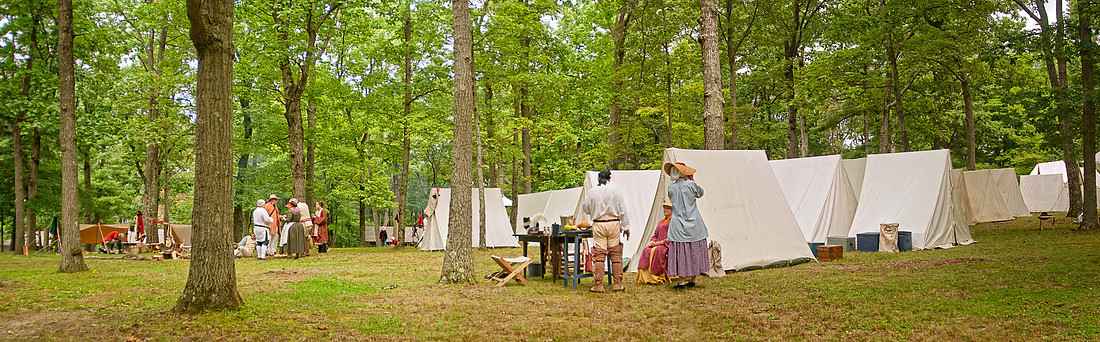
This photograph captures the participants, the action, and the full scope of the reenactment experience, allowing viewers to appreciate the event's scale and atmosphere. It is from the Battle of Newtown in 2019. My goal is to show the full scope of the encampment, which is the main focus here.
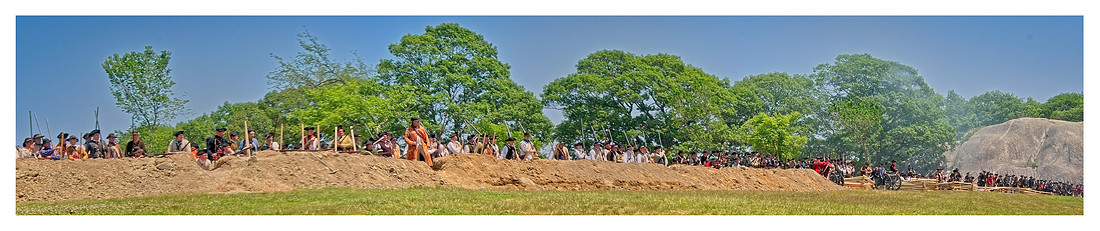
 This photo was taken during day 2 Battle of Bunker Hill reenactment, one of the highlights of my American Revolution photography experiences. As the British forces advanced up the hill, it felt as if I had been transported back to June 17, 1775. The action was intense and nearly nonstop, continuing until the militia was finally forced to retreat.
A single traditional photograph could never fully capture the anticipation and tension of the militia waiting for the British attack. That's why this panoramic image is so meaningful to me—it conveys the scale of the moment and the uncertainty before the battle erupted. The entire reenactment was incredibly immersive and gave me chills, making it one of the most memorable historical events I have ever photographed.
 Sometimes the best photographic opportunities come when I’m not focused on the reenactment itself. This photo was taken at the Battle of Fort Mercer reenactment in 2022, where visitors descend a staircase leading down to the park area along the Delaware River.
As I was walking the grounds, I immediately noticed this scene. The strong symmetry of the composition caught my eye. I captured the image handheld, concentrating on keeping the lines balanced and centered.
What I enjoy most about this photograph is its simplicity, just a quiet, visually pleasing moment that highlights the beauty of the setting. It serves as a reminder that some of the most rewarding images can be found away from the main event, simply by slowing down and paying attention to your surroundings.
 This photo from the Battle of Germantown reenactment in 2018 feels different to me because my eyes immediately dart left and right across the scene. Instead of settling on one focal point, I scan the image much faster than most of my other reenactment photos, almost as if there's no single place to stop and look. Does your eye move across the photograph the same way, or is it just me?

Fort Mifflin, located along the Delaware River near Philadelphia International Airport, is often called "The Fort That Saved America." That title comes from the extraordinary stand made by its small Continental garrison during the Siege of Fort Mifflin in the fall of 1777.
After defeating George Washington's army at the Battle of Brandywine and occupying Philadelphia, the British needed to open the Delaware River to supply their troops. Standing directly in their path was Fort Mifflin.
For more than six weeks, a vastly outnumbered American force defended the fort against relentless bombardment from British warships and artillery batteries positioned on both land and water. Despite horrific casualties and overwhelming destruction, the defenders refused to surrender, buying precious time for the American cause and earning the fort its enduring nickname.
This photograph was taken during Fort Mifflin's annual Siege Weekend event in 2021. It is one of my favorite living history events of the year. Being so close to my home makes it especially convenient, but what truly sets it apart is its unique location beneath the flight path of planes landing at Philadelphia International Airport. Aircraft pass directly overhead throughout the day, creating a striking contrast between the modern world and the 18th-century battle unfolding below. I often wonder what passengers are thinking as they look down and see the fort beneath them—especially when skirmishes are taking place.
For this photograph, I was standing atop the highest rampart overlooking the Delaware River. The dark, stormy clouds gathering overhead added a dramatic atmosphere to the scene.

I’ve enjoyed using ON1 Software on my photos since I began photographing American Revolution reenactments in 2007. Every image on my site is processed with this program. It’s an essential part of my workflow, and I often feature it on my blog because I truly depend on it. I personally edit every photo here, and ON1 remains a reliable post-processing tool.
Interested in ON1 Software? Click the image below and enter code AFFILIATE20 to save 20%. Try it—you won’t be disappointed!
As I reviewed this collection of panorama photos, one classic rock song kept playing in my head. With image after image stretching across the screen, I thought of "The Long and Winding Road," made famous by The Beatles. Released in 1970 on the Let It Be album, the song became the Beatles' final No. 1 single in the United States. Its title felt fitting as I reflected on the long and winding journey that led me to capture these sweeping panoramic views of American Revolution reenactments over the years.
Thank you for reading! Blog #115 will be posted on August 1, 2026. Be safe & well!
Huzzah,
Ken Bohrer

