|
Welcome to my website! For years I've been trying to combine 2 of my interests-photography and studying the American Revolution. By photographing American Revolution reenactments, I can now combine both interests. I now live in the Philadelphia area, so I'm centrally located to photograph many of the reenactments in the Delaware Valley region. My future goal is to photograph every major American Revolution reenactment. Plus, it's fun, and all reenactors want to share stories; they're storytellers! Ken "It was a pleasure to exchange cards. We are out of Lebanon, CT and I have reviewed website and was truly moved by your art." Brown's Company Visiting the Museum of the American Revolution (MAR) in PhiladelphiaThe Philadelphia region has access to many museums and historical sites, especially in Center City. The Museum of the American Revolution (MAR) opened in April 2017 and I haven't visited yet. So a few weeks ago, on a beautiful Sunday morning, I packed my lunch and took the SEPTA train from the suburbs to the city. The train ride was about 30 minutes. At the last stop, I had to walk about another 10 blocks to the museum. The MAR is located 3rd Street and Chestnut only a few blocks away from Independence Hall, The National Constitution Center and other great museums in the area. Years ago this was where the old Independence Hall Visitor's Center was located.
After obtaining my ticket I stayed on the ground floor and immediately headed for the Gift Shop. Browsing, I started mentally compiling a list of books to add to my reading list. Directly across from the Gift Shop was the Patriot’s Gallery.
It was set-up as a child's playroom. I noticed adults and their kids playing dress up in colonial clothes & pretending to be soldiers with wooden toy muskets. Other children were involved in arts and crafts such as making a paper replica of Washington’s Tent.
Although I had already had lunch I visited the Cross Keys Cafe. What a great place to relax and get a quick snack. Next time I'll have lunch here. Then went to the Lenfest Myer Theater to view a short 15-minute orientation film about the American Revolution.
When you climb the spiral staircase to the 2nd floor you notice huge paintings showing Washington's Crossing, Valley Forge and the surrender at Yorktown. As you enter the exhibits you immediately view a large mural of protesters tearing down King George's III statue in NYC.
The museum is comprised of 4 main themes, Becoming Revolutionaries, The Darkest Hour, A Revolutionary War and A New Nation. Today my focus was to get an overview of the museum so I didn't stay in one spot too long.
The more I continually learn about the American Revolution has made me appreciate, on both sides, the dedication and sacrifices that were made by all involved. I'm in awe of their fortitude and courage!
Definitely, the highlight was seeing George Washington's sleeping & war tent used during the war. In the small theater, there is a short film describing how the tent was used and what happened to it after the war. Interesting story. Then slowly a curtain rises and you see the tent. It made me think of the hardships and ordeals Washington had to endure in this 8-year war.
Soon I'll visit again and spend more time in each of the exhibits. Here is the MAR's website https:/www.amrevmuseum.org I also want to visit The American Revolution Museum at Yorktown in VA Funny how both museums opened about the same time. Thanks for reading! Blog # 5 will be posted in November 2018 featuring an interview with Paul Loane.
My Colonial Williamsburg ExperienceWhere do you go just to relax? Is it the beach, mountains or a big city? For me, it’s visiting Colonial Williamsburg! As a young boy, many years ago, I remember my family visiting often during my summer breaks. It was a long trip driving (about 8 hours) from Long Island to Williamsburg, VA. On every visit, I would receive a new toy cannon to add to my extensive collection. For years, I always wanted a tricorne hat. Just like the one below. Eventually, when I was older it happened. I was thrilled!
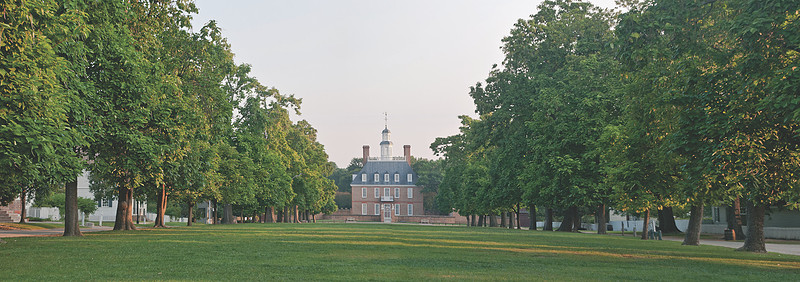
My parents always had reservations at the same hotel. Recently, my wife & son (3 1/2 years old) stayed there too. In the bathroom was a wall mounted bottle opener that I remembered from all my visits as a youngster. Old memories immediately came back! Now my goal is to visit Colonial Williamsburg yearly to create new special memories with my family. Soon my son will be asking for that tricorne hat! How to describe Colonial Williamsburg? It is an over 300-acre living history museum that includes 88 original 18th-century structures. For 80 years from 1699 to 1779, Williamsburg was the capital of VA, the largest colony in America at that time. In 1780 the capital moved to Richmond. The town, except for the College of William & Mary, was virtually forgotten. Then in the late 1920’s the Reverend Dr. W.A.R. Goodwin rector of Williamsburg’s Bruton Parish Church convinced John D. Rockefeller Jr., the wealthy son of Standard Oil fortune to restore the historic town to its 18th-century appearance. A fantastic book that shows this remarkable transformation is Williamsburg Before & After by George Humphrey Yetter colonialwilliamsburg.com/Williamsburg-Before-and-After My ideal day is to arrive in town just before sunrise. I bring a large cup of coffee and my SLR camera attached with the all-purpose 24-85 mm lens. Most mornings I’ll usually observe W&M students jogging, retired folks walking their dogs, and/or maintenance crews in their pick-up trucks cleaning the area. Between the Wren Building and the Capitol, a short distance of less than a mile, I get to stroll around the town where so many of our Founding Fathers developed their political ideas. It’s amazing that Washington, Jefferson, Madison, Henry, etc. walked these same streets. Even Benjamin Franklin visited here as postmaster twice in 1756 & 1763. It’s not difficult capturing great photos in such a wonderful place. A photo below of the Governor's Palace. One early morning, I was walking near the capital and notice a ladder on the side of one of the buildings. See below. I looked closer and immediately knew it would make a great photo. What do you see? To me, the ladder looked like a person’s mouth, the windows a pair of eyes, and the roof shingles hair. One of my favorites. Makes me smile.
Over the years special reenactment events occur. When it’s held in June, unfortunately not recently, Under the Redcoat depicts the British occupation (for about 10 days) of Williamsburg in 1781. Below are some photos from this program.
Another wonderful event that I hope occurs again soon is Prelude to Victory. This event celebrates the anniversary of George Washington & the French General Jean-Baptiste Donatien de Vimeur, comte de Rochambeau and their armies stopped in Williamsburg for a few days rest before proceeding on to Yorktown for the last major battle of the war. I had the opportunity to speak with Marquis de Lafayette portrayed by historical interpreter Mark Schneider. Of course, he was in character. He has also interpreted "Bloody Ban" Banastre Tarleton. You never know who you might meet when you visit. Click here for more information about Colonial Williamsburg www.colonialwilliamsburg.com
Later next month I have family members visiting from abroad. Of course, we will be traveling to Williamsburg for a long weekend. Luckily, the drive won't be as long, about 5 hours, since I now live in the Philly suburbs. Thanks for reading. Blog # 4 will be posted in October, 2018. Ken Bohrer
Photographing American Revolution Reenactments-Blog # 2It’s hard for me to believe that I’ve been photographing American Revolution reenactments now for over 10 years. On my photography website AmericanRevolutionPhotos.com there are over 5,000 photos and 12,000 visitors. I’m fortunate to live in the Delaware Valley region where so many Revolutionary Era events are held annually. I’ve also had the opportunity to travel from Boston, MA to Greensboro, NC photographing other reenactments. Many of my photos have been published in numerous books and magazines including Popular Photography magazine. How did I start focusing on this type of photography?
Since I was young, I’ve always been interested in studying the American Revolution. This period of history has always just fascinated me. When I first moved to the Philadelphia region and started attending reenactments, I reviewed numerous American & British regiments websites. To be honest, I wasn’t impressed with the photographs posted. I knew I could do better. In the beginning, I was just hoping to catch a few musket or cannon flash photos at these events. After so many years of practice, it now occurs almost every time. Above is an example. When I reviewed this photo from the recent Battle of Monmouth, I was still thrilled. I’ve been asked often, how do you capture these images? I honestly say, don’t know. My camera allows me to shoot in rapid fire, almost 8 shots a second! But I’m definitely doing something right. It’s fun to hear the camera continuously clicking, in rapid fire mode, when I hit the shutter release button. But, I recognized eventually that there is more to the reenactment experience than the actual reenactment itself. About 5 years ago, I was speaking with one of the ladies cooking lunch in the Continental camp. She was familiar with my website and her first remark to me was a quote from Abagail Adams “to remember the ladies.” I understood immediately what she meant! I was only photographing the reenactments and missing the camp life experience. From then on, I made sure to visit both the American & British camps when I first arrived at any event. Plus, it’s important for photographers to try new and interesting artistic techniques. Should the photo be in color, B&W, photo dimensions, panoramas, etc.? Recently, I purchased knee pads (less than $15 at Home Depot) so I could get different angles and vantage points by being low and shooting upwards. Everything appears to be so much larger in the photos. Plus, it’s easier to crop out any unnecessary elements later if warranted. A photo below, while on one knee, of the British camp.
Below is my favorite photo from the Battle of Monmouth reenactment. Why? Before the reenactment started, I conceptualized the photo in my head when I saw the British troops marching in the distant cornfield. The contrast between the green field and British red uniforms makes this image unique. Plus, it’s also colorful and one of a kind photograph. Do you agree? I’m lucky too. Not everyone has the essential equipment to capture this photo. When I attach my 1.4 teleconverter (extends lens distance) to my long 80—400 lens it becomes an 840mm. I'm capable of photographing almost anything very far away!
Thanks for reading! Blog # 3 will be posted in September, 2018! Ken Bohrer
Interview with Captain David HospadorJune 16, 2018 I was excited to drive the 1 ½ hours for the Battle of Monmouth 240th anniversary reenactment in Manalapan, NJ. Since 2008, I’ve only missed this event a few times and that was because of health issues. Some of my best photos were taken here. In fact, one of them is on the back of my business card. Why do I enjoy this event so much? Its location is one reason. When walking behind the visitor’s center you just stop and gaze at the background. You see a cluster of trees sporadically growing everywhere and in the center a big grass field sloping gradually downward. In the distance is a huge corn field. Everything is so green. It’s so stately. This awe feeling happens every time I come here. But this Saturday was special. I was interviewing Captain David Hospador of the 3rd PA Light Infantry, Commander of the American forces. I knew David from chatting at many of the events over the years. He is one of my favorite reenactors to photograph, so animated. Some of my favorite photos are of him in action. The weather was better than in most years. It wasn’t as hot. Usually, the temperature is in the high 90’s with stifling humidity. Very similar to what had happened at the actual battle. Many soldiers on both sides died from heat fatigue. Besides the extreme weather, this famous battle is known for the usually stoic George Washington losing his self-control with his second-command General Charles Lee. He retreated from the battle because he didn’t believe his troops could defeat the British regulars. Also, the legend of Molly Picher was created here. She (probably Mary Ludwig Hays) allegendly manned her husband's cannon when he was killed and in the battle a cannonball whizzed between her legs tearing off her most of her petticoat! www.americanrevolutionphotos.com/p1038957122 Interview with Captain David Hospador of the 3rd PA Light Infantry- 1) You’re one of my favorite reenactors to photograph, so animated. You really appear to enjoy yourself during the events? Thank you, I truly love this hobby, the history, the people and the idea that we are remembering those men and women who lived during this time and those who fought in the war. As for my liveliness in the field, it spawns from the fact that I lead my unit on the field and I need them to follow my lead and do, without question, what I order them to do for me. So I will go over and above to maintain control, also its fun to be an officer. 2) How long have you been reenacting? Since the beginning of 2002. My one wish is that I started doing this earlier in life. 3) How did you join the 3rd PA? Did you consider other units? My wife's hairdresser was a member of the unit. When we became engaged she told me I had to meet Bob, her hairdresser. I asked her why I needed to meet Bob the hairdresser. She told me how he does this Revolutionary War reenacting and that I might be interested in doing it for a hobby, she was right. 4) Ever thought of joining a Crown forces regiment? If not, why? Nope, red-blooded patriot here. I will say this, I love my British counterparts and I'm thankful that they wear the scarlet uniform. I consider man of them my friends. 5) How many Rev War events do you attend yearly? Do you have a favorite one? Why? 15-20 events ranging from one day living history to weekend long reenactments. 6) What is your greatest enjoyment from reenacting? It's a toss-up between the wonderful friendships I have with my fellow reenactors, especially those in my own company and recreating the history for people to learn from and enjoy. 7) This can be an expensive hobby! What does the average Rev War kit cost? Can any of your equipment be written off taxes? As it is an educational resource some of what we do is tax deductible. It can get expensive, a good musket can run over $1000. My unit is lucky, we make a lot of our own clothes and equipment. What also helps is that we have, what we call, loaner gear for people who want to try the hobby before investing money in it. 8) What do you hope the spectators who attend will learn? Something that they weren't taught in their history class. Many of us have learned so much from our research and we love to share it with others. 9) What’s your thoughts on the future of Rev War reenacting? I believe social media will play an important part in the future of the hobby. Our participation numbers have been dwindling over the past 15 years and it will take work to bring people into the hobby. 10) How do you learn more about colonial history? Honestly, in this day of electronic media and internet video/encyclopedias, my favorite source is still a good book or original material. My unit has a copy of our Orderly Books from April 1778 through the end of the war it makes for great reading. 11) What books do you recommend about the American Revolution? There are so many I couldn't recommend a handful let alone one! 12) Any question I missed? Yes, how long were you a private, non-commissioned officer and then an officer? I was a private for around 4 years, then I was appointed as a corporal then a sergeant for another 5 years, then I was elected the officer in 2012. 13) What's the difference between being an enlisted man and an officer? As an enlisted man I was concerned with my clothes and equipment and learning the drill and working with the other guys in the company to be good and safe in the field, learn the history and other stuff on an individual level. As an officer, I have to oversee the men and women in the company, make sure they learn what they need to learn, and to run the company behind the scenes, which is no small feat. I'm responsible for everything. NEXT BLOG POST: August,2018-Photographing American Revolution Reenactments
Newer Posts »
© American Revolution Photos
|