Battle at Chadds Ford 2026

The Battle at Chadds Ford 2026 Reenactment, the major historical event closest to my home, commemorates the Battle of Brandywine, fought on September 11, 1777. Through battlefield skirmishes, military drills, artillery demonstrations, and Revolutionary War encampments, the event brings the American Revolution's largest single-day battle vividly to life.
Hosted by the Chadds Ford Historical Society, the reenactment honors the soldiers and civilians whose lives were shaped by the historic conflict while educating visitors about the battle's strategy, daily life, and lasting significance through living-history programs and interactive demonstrations. This year's event held special meaning for me, as it was my first major outing since my knee replacement surgery in late April. It was wonderful to reconnect with reenactor friends, fellow photographers, and sutlers while enjoying a weekend immersed in history.
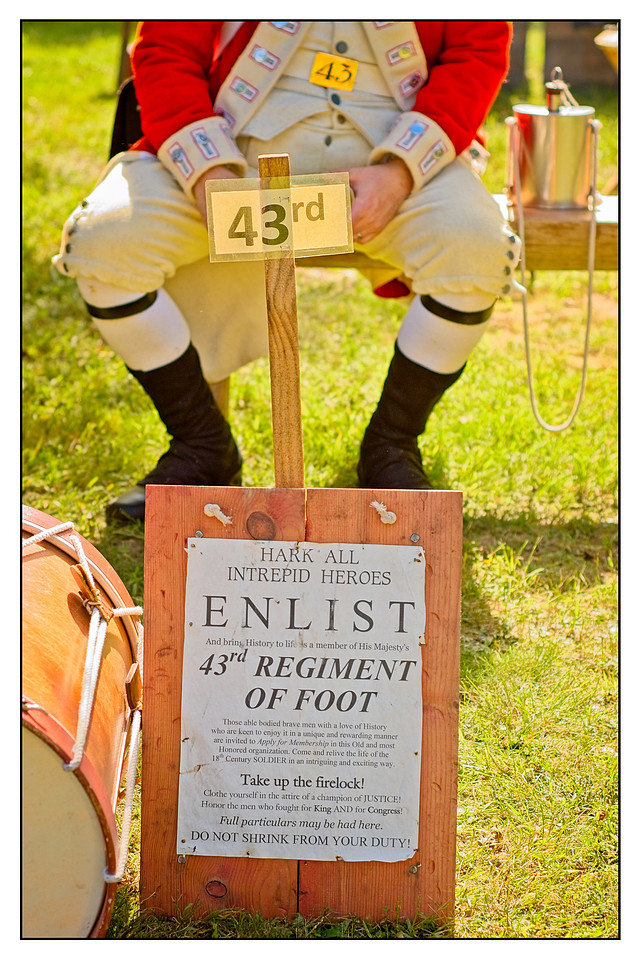
Sometimes the best photographs present themselves in an instant. While chatting with a friend, I glanced to my left and noticed a British soldier seated on a bench. What immediately caught my attention was the number 43, representing the 43rd Regiment of Foot, displayed on his belt plate. Looking a little closer, I spotted another 43 on the stake beside him and yet another on the enlistment flyer resting nearby. The unexpected alignment of those three matching numbers created a composition too good to ignore. I quickly paused the conversation and captured several frames before the soldier moved on. Timing is everything in photography, and moments like this remind me how much luck can shape a memorable image.

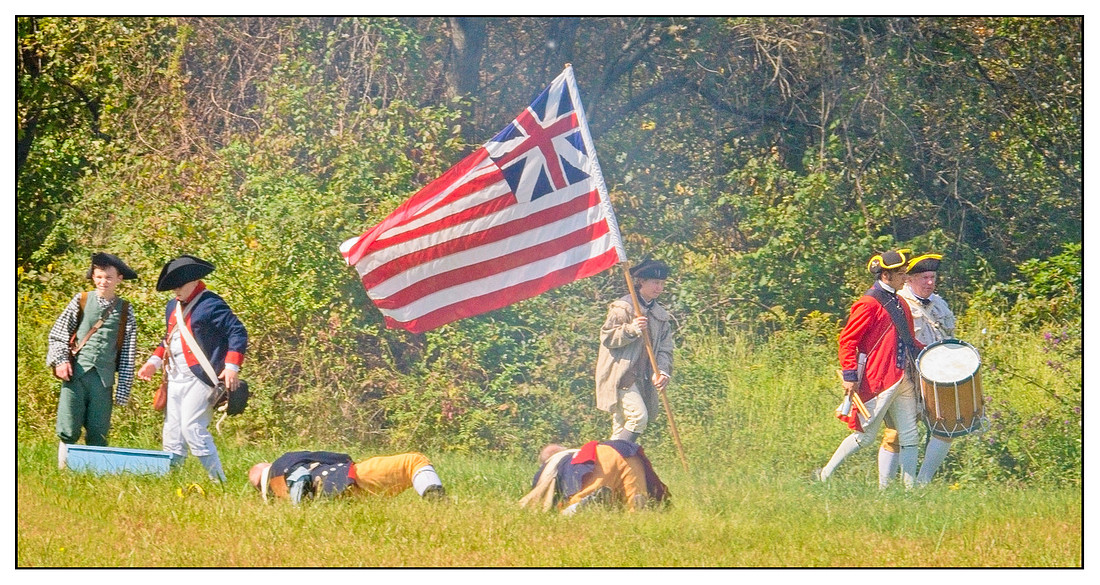
Capturing a flag fluttering in the breeze is always a highlight at any event. This particular design, however, wasn't one I recognized, so I did a little research.
What I discovered was interesting: it appears to be the British Grand Union Flag, sometimes known as the Continental Colors or Congress Colors when used by American forces during the Revolutionary War. The flag combines the British Union Jack in the canton (upper corner) with thirteen red and white stripes representing the colonies.
Today, many Revolutionary War reenactment groups and historical interpreters display this flag to reflect the early stages of the American Revolution, before the adoption of the Stars and Stripes. The flag itself was not unique to any single regiment, making it a fitting choice for a variety of historical portrayals.
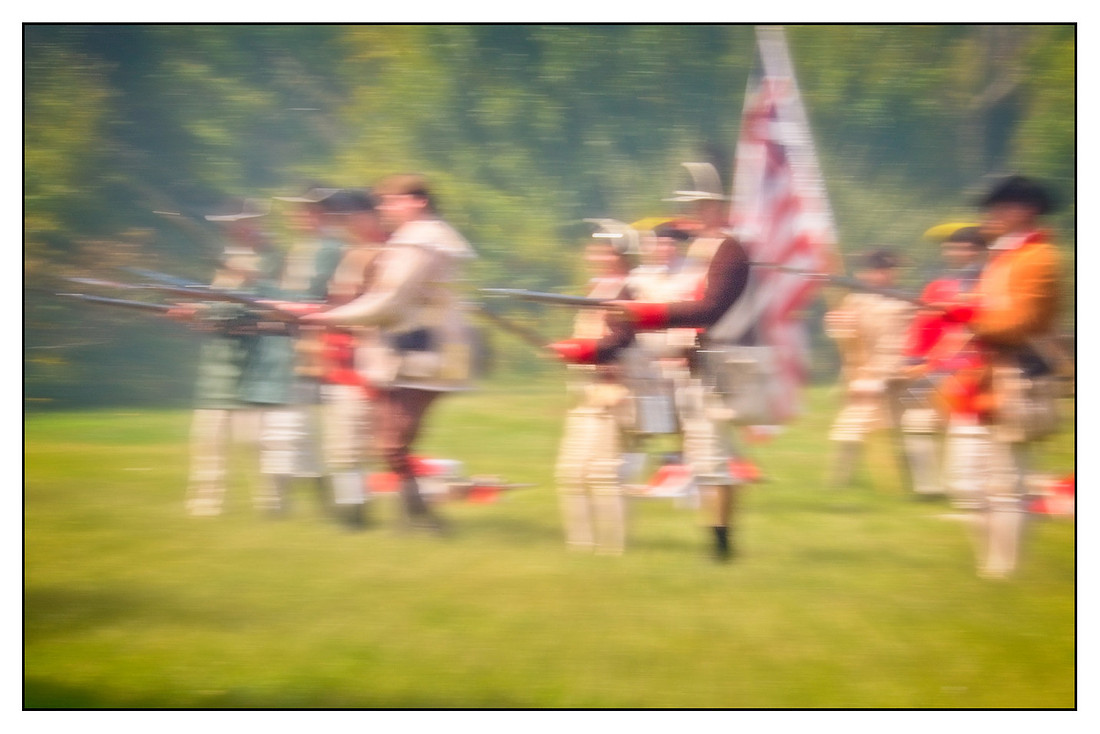
 One reality of photography is that not every image wins. During post-processing, I often delete far more photos than I keep. Every so often, though, a photograph that initially seems like a failure reveals unexpected potential. That's exactly what happened with this image.
When a bayonet charge happens at a reenactment, I usually use a right-to-left panning technique to create a sharp action shot that captures the speed and intensity of the moment. More often than not, those images fall short of my expectations, and my first reaction to this one was that it was simply out of focus. Still, something about the composition and movement made me pause before rejecting it.
I began by applying the same basic adjustments and filters I had used on the other photographs from the event. The image truly came to life when I added a radial filter. Instead of trying to minimize the blur, I chose to embrace it.
What initially seemed like a flaw became one of the photograph's greatest strengths. The motion blur now draws the viewer into the action, creating energy, urgency, and momentum. This photograph reminds us that sometimes a "bad" photo isn't really bad at all. It just needs a different creative vision to reveal its potential.
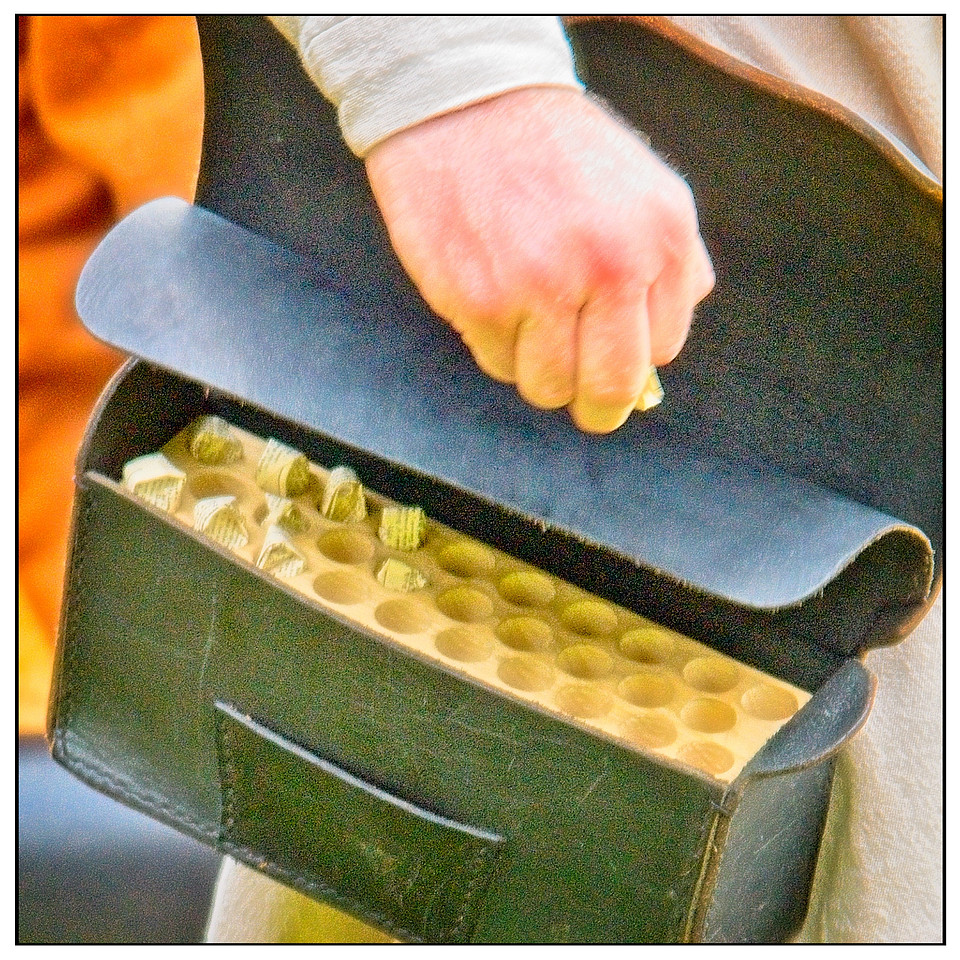
 Some photographs take years to happen. For years, I chased this shot, waiting for the right moment to capture a close-up of an open leather cartridge box during an American Revolution reenactment, with rows of tightly rolled paper cartridges neatly stacked inside. By zooming in on the cartridge box, I finally created the image I envisioned.
For American Revolution reenactments, people typically make paper cartridges by wrapping paper around a wooden dowel to form a tube, then tying, folding, or twisting one end before rolling it tightly. The finished cartridges closely replicate the appearance of the eighteenth-century ammunition soldiers carried, adding an important layer of authenticity to the reenactment experience.
 American reenactments and encampments are a lot of fun. They offer a history lesson and vivid glimpses into life during that period. Realistic? Not exactly.
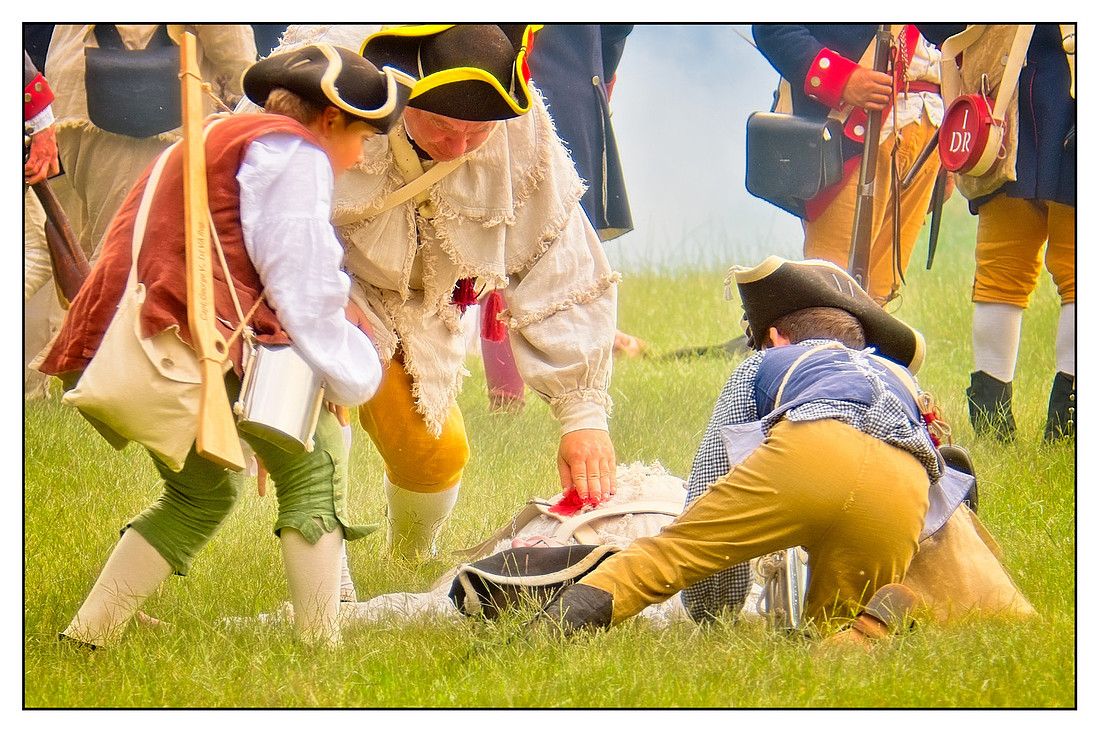
Only when reviewing this photo afterward did I notice that one soldier appeared to have been mortally wounded, complete with "blood" showing.
Most reenactors don't actually "die" during a battle scenario. In fact, I've often overheard spectators wondering how dozens of musket volleys can be exchanged without anyone falling. What I've learned is that reenactors typically don't decide beforehand who will become a casualty. Sometimes someone takes a hit because they're bored, tired, or simply out of cartridges. Sometimes it's all three. And now and then, a reenactor chooses a particularly heroic ending.
As a side note, the reality of the war was far different. More soldiers died from disease and illness than from wounds suffered on the battlefield, a reminder that camp life and poor sanitation were often deadlier than combat itself.
 While writing this blog, I didn’t think of a particular classic rock song, but of a group, Paul Revere & the Raiders. They were a popular American rock band from Boise, Idaho, who dressed in American Revolution replica uniforms with a three-cornered hat, and whose energetic sound and colonial-era stage image helped make them one of the most successful U.S. groups of the 1960s.
During their peak years, they achieved 12 Top 30 hits on the Billboard Hot 100 and earned three gold-certified albums, establishing them as a major force in American rock music.
Thank you for reading! Blog #121 will be posted on November 1, 2026.
Huzzah,
Ken Bohrer


I’ve enjoyed using ON1 Software on my photos since I began photographing American Revolution reenactments in 2007. Every image on my site is processed with this program. It’s an essential part of my workflow, and I often feature it on my blog because I truly depend on it. I personally edit every photo here, and ON1 remains a reliable post-processing tool. Interested in ON1 Software? Click the image below and enter code AFFILIATE20 to save 20%. Try it—you won’t be disappointed!